
>According to the latest RBI data, PPF receipts have already experienced a decline between April 2023 and February 2024. Other schemes like the Sukanya Samriddhi Account and National Savings Certificate are also witnessing reduced inflows.

'We are in a position to start due diligence and private data room access shortly.'

The government on Tuesday sought to address a significant concern stemming from the 2024-25 Budget announcement by introducing flexibility in the computation of long-term capital gains (LTCG) tax on unlisted assets, including properties. For any assets, such as land or buildings, acquired before July 23, taxpayers can choose between the new and old regimes, opting for whichever results in a lower tax liability. Under the new LTCG regime, the tax rate is set at 12.5 per cent without the benefit of indexation.
Of the two rate structures on the table, one suggests tax slabs of 8 per cent, 16 per cent, and 24 per cent. The other proposes tax slabs at 9 per cent, 18 per cent, and 27 per cent.

The platform recorded a peak rate of 917 filings per second on July 17 and 9,367 filings per minute on July 31.

The income-tax (I-T) department has started scrutinising cases for the assessment year (AY) 2018-19 to determine which of them need to be reopened, a process that might result in a raft of tax notices. This follows this year's Union Budget move to reduce the time limit for tax reassessment from 10 years to five in cases of escaped income. The new provision becomes effective on September 1 and will make past assessments for AY 2018-19 time-barred.

'We have now drastically simplified it, primarily to two rates in long-term capital gains: 20% and the applicable rates. Similarly, in short-term capital gains.' 'For listed shares, there is a slight increase, but for unlisted shares, where indexation benefits are removed, there is a reduction in rates, benefiting unlisted companies, venture capital firms, etc.' 'Similarly, in real estate, wherever returns are higher, the new structure is beneficial. In very few cases, returns are lower, and those are more of an exception.'

'I found it unbelievable that L&T said 45,000 jobs were waiting to be filled because of unavailability of suitable skillsets.' 'So, when the Opposition sweepingly says there are no jobs, I'm sorry... I'm not saying it's raining jobs, but there are jobs. The (skill) gap has to be bridged.'

The finance minister continues to be backed by the same policy team in charting out the broad strategy as in the few earlier Budgets.

Alloting more funds for MNREGA and PM-KISAN could wipe out the entire additional money that the Centre may have for FY25.

Average monthly GST collection rose from Rs 90,000 crore during the first year of its implementation -- 2017-2018 -- to Rs 1.68 trillion during 2023-2024, representing an 87 per cent rise.

Adding petrol and diesel to GST was a challenging task due to their significant role as revenue generators for both the central and state governments.
In a relief for foreign firms giving loans to Indian subsidiaries, tax authorities have said goods and services tax (GST) will not be imposed on them, subject to some caveats. Additional fees, commissions, or related payments - over and above the amount charged as interest - on these loans will attract GST at 18 per cent, the Central Board of Indirect Taxes and Customs (CBIC) has said.

Amid the Budget preparation, the revenue department is assessing the feasibility of further adjustments to maximise benefits for salaried individuals.

'Any finality in such matters requires political views. We will review it closer to the full Budget.'
The Goods and Services Tax (GST) Council, scheduled to meet on June 22, could take a call on ending uncertainty on taxing foreign airlines and shippers as regards certain services, a senior official in the know told Business Standard. He said the Council was expected to decide on exempting the services in question from GST - aircraft lease rentals, maintenance, crew salaries, etc. These services are provided by foreign airlines to their Indian operations.

Fresh plans of privatisation or divestment in central public sector enterprises and public sector banks might take a back seat this financial year because these may require a large consensus among coalition partners.
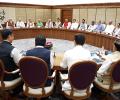
'The expeditious enactment of labour codes and strategic measures to bridge the skills jobs gap are critical.'

The Central Board of Indirect Taxes and Customs (CBIC) has stepped up its watch on the import of unbranded gold jewellery amid a spurt in seizures on international borders and from importers. During FY24, the CBIC and Directorate of Revenue Intelligence (DRI) jointly seized about 5 tonnes of gold, 30 per cent more than what they did in FY23. In FY23, 3.5 tonnes of gold was confiscated.

The fitment committee under the Goods and Services Tax (GST) Council, comprising central and state officials, has begun a rate rationalisation exercise afresh, checking the possibility of dropping some of the rates, particularly the 12 per cent slab, to achieve a revenue-neutral structure, a senior official with direct knowledge of the matter
 © 2025 Rediff.com - Investor Information - Advertise with us - Disclaimer - Privacy Policy - Sitemap - Feedback - About us - Terms of use - Grievances